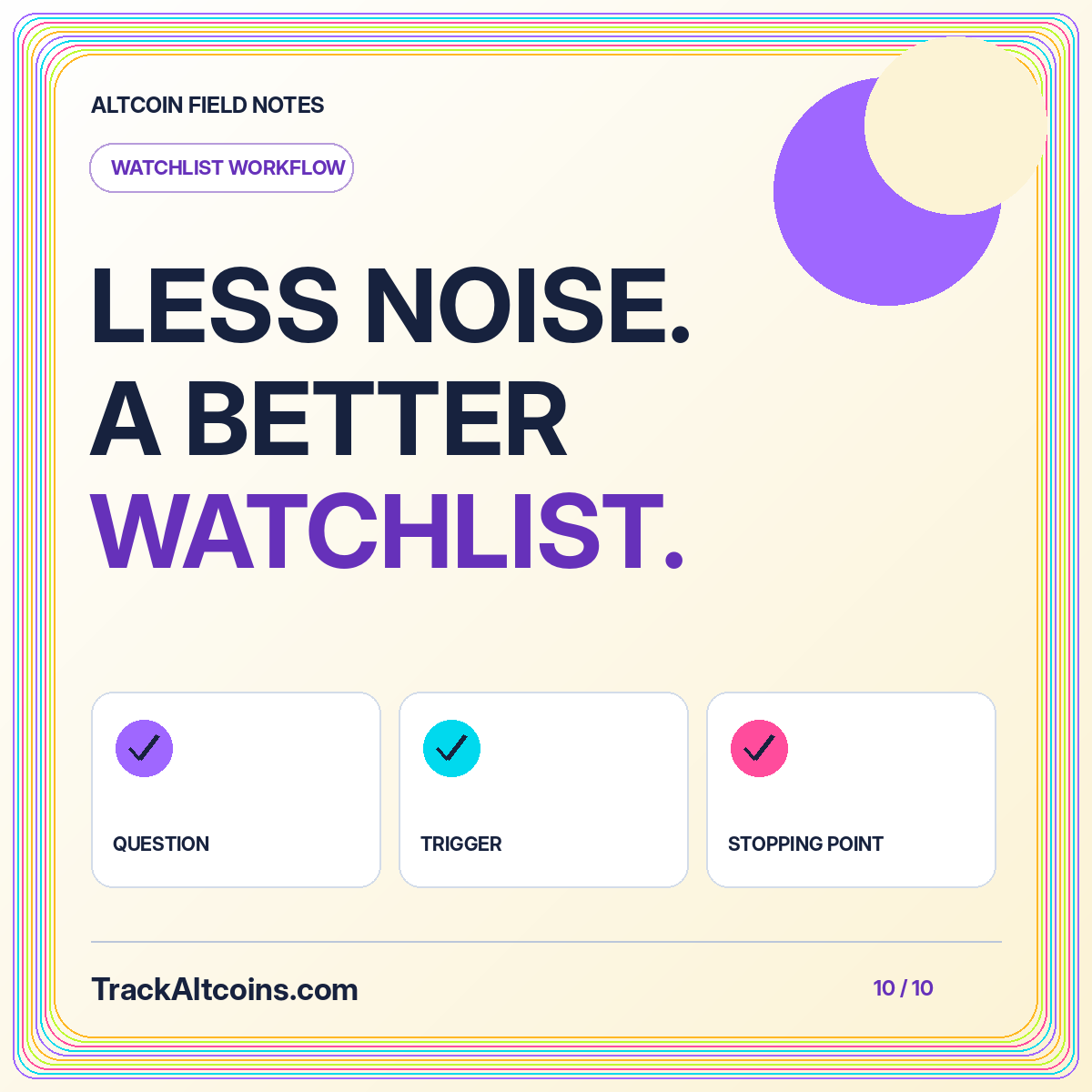
Build an Altcoin Watchlist That Reduces the Noise
Create a research watchlist with verified identities, clear questions, review triggers, and sensible archive rules.
Read the field notePortfolio & Wallets
Separate deposits, internal transfers, fees, and investment returns when organizing cryptocurrency portfolio records.
A portfolio balance can rise even when none of its investments has gained value. Deposits, transfers, rewards, changing exchange rates, and duplicated imports can all move the number on a dashboard. That is why a cryptocurrency portfolio tracker needs an accounting boundary before it needs a performance chart. Without that boundary, a neat total can tell the wrong story.
This guide explains how to organize quantities, transfers, and return calculations using hypothetical examples. It does not provide tax advice or suggest an allocation. Start with the portfolio tracking overview and keep the distinction between an observation, an estimate, and a reconciled record visible throughout your process.
List the wallets, exchange accounts, and other locations that belong in your record. A wallet outside the boundary is not automatically someone else's property; it may simply be a location you have not included. That matters because a movement between included locations is different from a deposit from outside the portfolio.
Assign each location a stable label. Keep an exchange account distinct from the blockchain addresses an exchange uses operationally. For your own records, a label such as “personal hardware wallet” is often easier to understand than a collection of truncated addresses. Keep sensitive identifiers in a secure private record rather than in a screenshot shared publicly.
A quantity ledger is the foundation. Record asset identity, location, units, observation time, and whether the units are available, locked, or pending. Price data should be attached afterward. Otherwise, a changing reference price can distract from the more basic problem that the number of tokens is wrong.
Use a simple balancing equation: starting units plus recorded incoming units minus recorded outgoing units should equal ending units, with separately recorded adjustments where necessary. For example, starting with 100 tokens, receiving 20, and sending 15 gives an expected ending quantity of 105. A mismatch is a research task, not something to hide with an unexplained adjustment.
A transfer of one token may involve a network fee paid in another asset. Record those movements separately. Do not subtract a native-asset fee from the transferred token's units just because the two actions appear in the same transaction. Keeping quantities and currencies explicit helps prevent small inconsistencies from accumulating across many records.
Suppose you send 10 hypothetical tokens from wallet A to wallet B, and both wallets are inside your boundary. Wallet A decreases by 10 and wallet B increases by 10. The combined token quantity is unchanged before any separately recorded costs. Counting the receipt as investment income would overstate the result.
Match transfers using the available transaction identifier, asset identity, destination, and timing. Do not rely exclusively on equal amounts because fees, partial processing, or unrelated transactions may complicate the comparison. Keep uncertain matches in a review queue. The onchain transaction guide explains why movement alone does not reveal the economic purpose of a transaction.
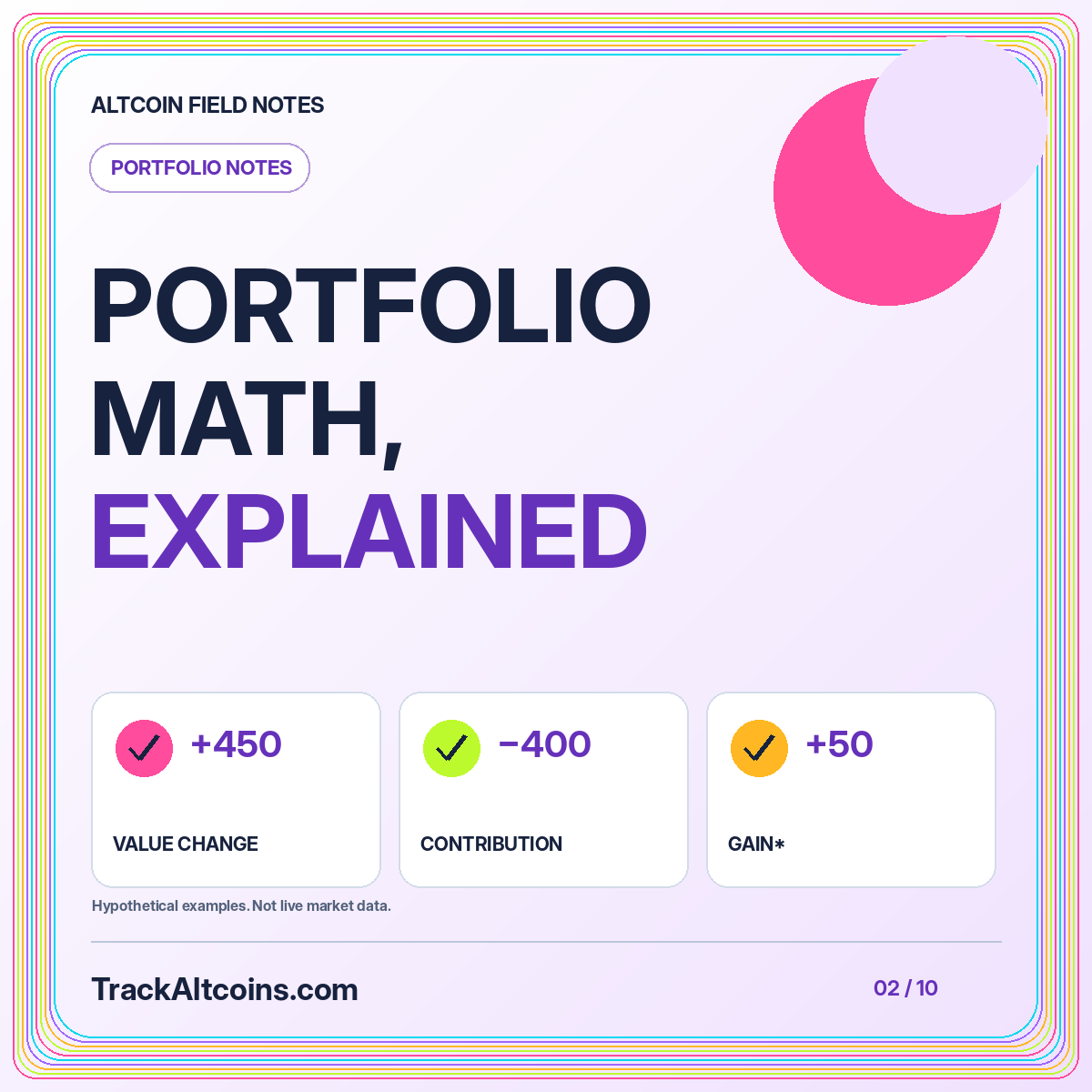
Consider a portfolio worth 1,000 units at the start of a period. You add 400 units immediately before the ending valuation, which shows 1,450. The raw increase is 450, but only 50 remains after subtracting the contribution. Under this deliberately simple timing assumption, dividing 50 by the starting 1,000 gives a 5 percent gain.
Now move the contribution to the middle of the period. The same ending value no longer tells you the return earned on each amount while it was invested. Cash-flow timing matters. A tracker should explain its chosen method rather than present a percentage with no definition. “Value change” is an honest label when a proper return calculation has not been performed.
One approach divides performance into periods around external cash flows and links the resulting returns. Another considers the timing and size of the investor's cash flows when solving for a return. These methods answer related but different questions. Neither becomes meaningful until the transaction history and valuations used in the calculation are consistent.
For example, a large contribution just before a decline can affect an investor's experience differently from a contribution after the decline. Rather than choosing the method that produces the more flattering result, name the question you are answering. When historical prices or exact timing are unavailable, disclose the approximation instead of displaying unnecessary decimal precision.
An unsold position's estimated value is different from the result recorded after a disposal. Keep acquisition records, disposal proceeds, fees, and remaining quantities connected. A dashboard showing only the current value cannot reconstruct every earlier transaction. Missing history should remain visible even when the current balance appears correct.
A hypothetical position bought for 200 and later valued at 240 has a 40-unit unrealized increase before costs. Selling it for 235 with a 5-unit fee leaves 230 of net proceeds in this example. The comparison with the 200 acquisition amount is then 30, not 40. Actual tax treatment and cost-basis rules depend on jurisdiction and circumstances; obtain qualified advice when needed.
Holding several token names does not automatically create meaningful diversification. Ask whether multiple positions depend on the same network, bridge, application, counterparty, or underlying asset. A holdings table grouped only by ticker may obscure those shared dependencies. Add an exposure note rather than assuming every row represents an independent risk.
The Investor.gov diversification explainer describes diversification as spreading investments to reduce concentration, while noting that it cannot guarantee protection from market declines. For a crypto record, the useful organizational step is to distinguish the number of positions from the number of genuinely different dependencies. This guide does not prescribe a suitable allocation.
When units arrive as a reward, record the event, the asset, the quantity, and the evidence supporting that classification. Do not automatically call every incoming transaction a reward. An unsolicited token, a refund, an internal transfer, and a distribution require different explanations. Unknown transactions should remain unknown until there is enough context.
Locked or staked units also deserve a separate availability status. A quoted reference value is not the same as immediately accessible funds. Where a receipt token represents another position, document which record is being counted for valuation so that the same economic exposure is not included twice. Preserve both records for traceability without necessarily adding both values to the total.
At a chosen cutoff, compare recorded quantities against statements or chain observations. Review unmatched transfers, unsupported prices, duplicate entries, and changes in asset identifiers. Recalculate a small sample manually. Keep the previous reconciliation rather than replacing it, so that an unexplained change can be traced to the period when it appeared.
Avoid silently replacing an unavailable price with an old one. A stale estimate may still be useful, but it needs its original timestamp and a visible status. Our altcoins API guide shows how missing and outdated data can be represented without being mistaken for fresh observations. Accuracy includes knowing when the answer is incomplete.
Consider keeping two labels in a review: quantities reconciled and valuations available. You might have confirmed every unit in a wallet while still lacking a usable price for one asset. The quantity work remains valid, but the valuation is incomplete. Do not discard the asset or present the partial total as the complete portfolio value. A note such as “one holding has no current reference valuation” explains the limitation without inventing a number. This distinction is particularly helpful when comparing reports produced by tools with different asset coverage.
A trustworthy portfolio record starts with ownership locations, asset identities, and reconciled quantities. Match internal transfers, separate contributions from gains, and label the return method you use. Only then should the headline total become the focus. The most useful dashboard is one whose changes you can explain, including the parts that still require investigation.
Filed under Portfolio & Wallets. Research education, not a recommendation.
Keep exploring
Create a research watchlist with verified identities, clear questions, review triggers, and sensible archive rules.
Read the field noteBuild an altcoin research workflow with verified identities, useful measurements, timestamps, and an organized watchlist.
Read the field noteUnderstand market capitalization, circulating supply, and fully diluted valuation with practical examples.
Read the field note