Crypto Portfolio Tracking: Transfers, Balances, and Returns
Separate deposits, internal transfers, fees, and investment returns when organizing cryptocurrency portfolio records.
Read the field noteTracking & Research
Separate blockchain observations from identity claims and investment interpretations when researching transactions.
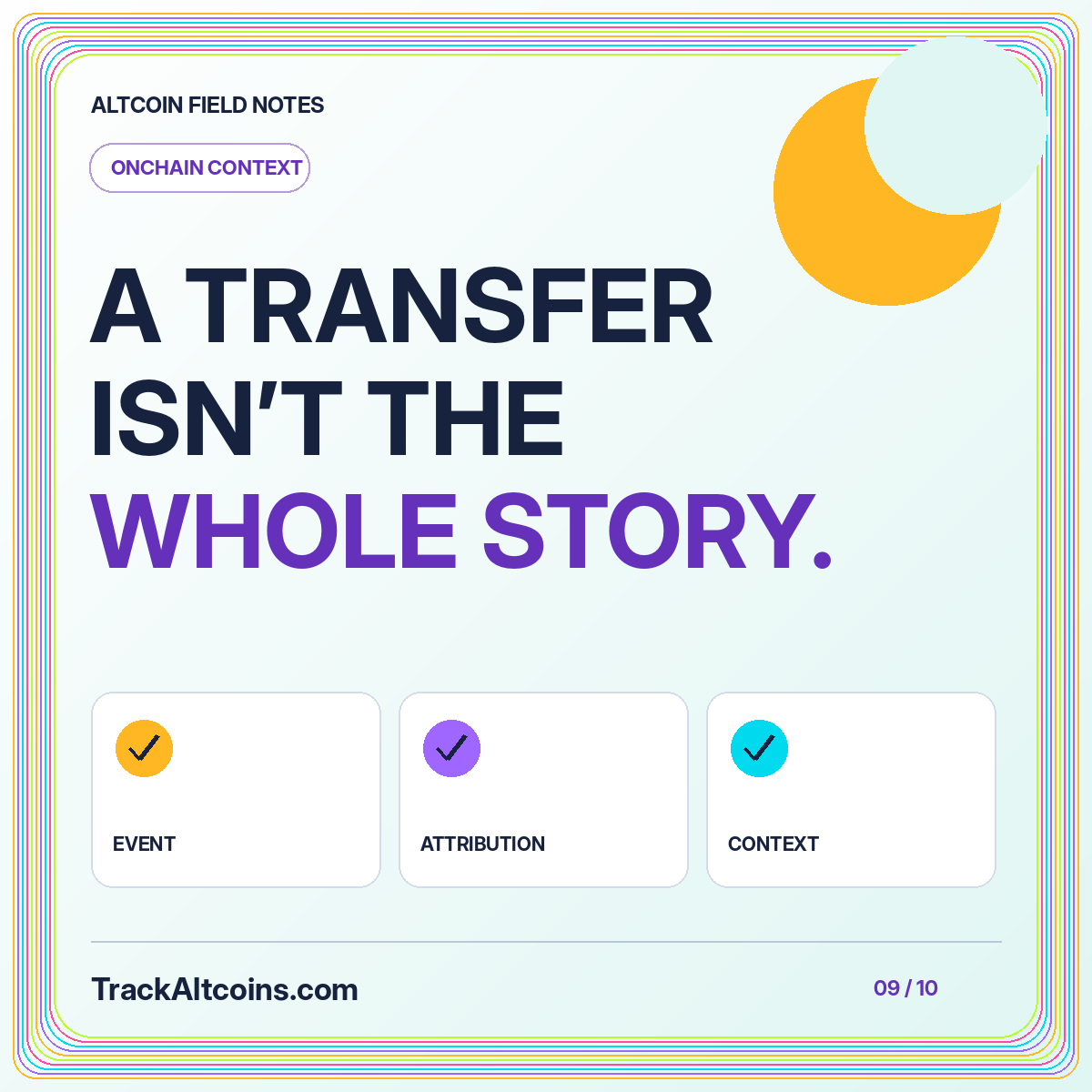
A large token transfer can attract attention without explaining very much. It might represent a payment, an internal movement, a contract interaction, a custody change, or another activity entirely. The transaction proves something about a network event; it does not automatically prove the owner's identity, intent, or investment view. Good onchain research keeps those layers separate.
This guide develops a cautious, read-only method for interpreting wallet activity. It is not a tool for identifying private individuals or a strategy for copying trades. Begin with the altcoin tracker overview and use the distinctions below to turn a transaction screenshot into a record that states what the evidence actually supports.
An observation describes what the network record shows: an account submitted a transaction, a particular contract was called, or a token balance changed. Attribution assigns the account to a person or organization. Interpretation proposes why the activity happened. These are different claims and may require different evidence.
Write your notes in separate fields. For example, “a transfer event names this destination” is narrower than “an investor bought this token.” The latter adds a claim about identity and economic purpose. If you cannot support those additions, retain the narrower description. Precision is more valuable than a dramatic narrative that later turns out to describe an internal movement.
Record the complete transaction identifier, the network, and the source used to inspect it. A transaction hash without network context may not be a sufficient reference for someone else to reproduce your work. Preserve the relevant block or confirmation information and the observation time. Do not rely entirely on a cropped image of a block explorer.
The Ethereum transaction documentation explains transaction fields and the role of signed instructions in changing network state. For research, the practical lesson is to distinguish the submitted transaction from its execution details and resulting state changes. An interface's summary is helpful, but it may not capture every action involved in a contract interaction.
A submitted or pending transaction is not the same as a successfully executed one. Establish what the available record says about completion and execution status. If you are looking at an event before the relevant confirmation point, label the observation accordingly. Do not turn an early preview into a statement that the intended economic action definitely occurred.
Keep the time of your check. A record that was pending when first observed may later complete or fail, and your research note should show that progression. Avoid replacing the first status silently. A small chronology makes it easier to understand why two screenshots taken at different times appear to disagree without either necessarily being fabricated.
A transaction's top-level value field does not necessarily summarize every asset movement produced by contract execution. Examine the relevant token events and state changes for the question you are answering. Conversely, the presence of a token event does not make every label supplied by an explorer an independent statement about the real-world purpose of that movement.
For each relevant movement, record the asset identity, amount, units, source, destination, and its relationship to the transaction. Keep native assets distinct from issued tokens and wrapped representations. Do not join movements simply because their symbols match. The Solana token guide illustrates how account models can differ across networks.
Use exact quantities where the source supports them, with decimals handled explicitly. Avoid interpreting a human-readable amount before checking its unit convention. An error in decimals can turn an ordinary movement into an apparently extraordinary one. Preserve the raw information needed to reproduce the display rather than relying only on a rounded value copied from a chart.
A transfer between two accounts controlled by the same entity may change location without changing total exposure. A movement into a contract may produce a receipt or claim rather than a straightforward sale. A bridge-related process may involve linked actions on more than one network. Each possibility needs evidence, not an assumption based on direction alone.
For personal reconciliation, use records you control to identify internal transfers. For external research, be explicit when control relationships are uncertain. “The assets moved to an address labeled by a third party as an exchange” is narrower than “the owner sold.” Even a well-supported destination label does not independently establish the eventual action taken after deposit.
Block explorers and analytics services may attach names or categories to addresses. Record the source and the scope of the label. Ask whether it identifies an operational address, a contract, a custody service, or an asserted owner. A label may be useful context without proving that every action involving the address belongs to a single customer or decision-maker.
Do not infer sensitive personal details or attempt to identify a private individual from an ambiguous address cluster. A public ledger can be studied without publishing speculative identity claims. Focus on the transaction structure and the evidence relevant to your stated question. Where attribution is not necessary, omit it rather than collecting it merely because a tool makes it possible.
Size can make an event worth inspecting, but it does not reveal intent. A large movement may reflect administration, custody, collateral, or an internal reorganization. The same visible pattern can have different explanations. Write down plausible alternatives and identify what additional evidence would distinguish them, without presenting any one alternative as established.
Copying a transaction after observing it also changes the circumstances. Timing, available liquidity, costs, and the original actor's broader positions may be unknown. This guide does not recommend copy trading. A research record should describe the observed event rather than imply that a later observer can reproduce its context or outcome simply by choosing the same token.
When an explorer, wallet interface, and portfolio tracker disagree, compare their scope before assuming one is wrong. One may display only selected token transfers, another may group contract actions, and another may apply accounting classifications. Identify the exact question each interface is answering. A difference in presentation is not automatically a difference in underlying chain data.
Trace one example from the transaction record through your normalized movement record into any portfolio classification. The portfolio accounting guide explains why the last step requires context about ownership and cash-flow boundaries. A technically accurate transfer list can still produce an incorrect profit calculation if the classification layer is careless.
A strong note includes network, transaction identifier, observation time, status, relevant movements, label sources, and unresolved questions. Add a short conclusion that stays within the evidence. For example, “the recorded movement is confirmed; the destination's economic purpose is not established” is a complete and useful result.
Preserve links or references needed to revisit the event, but avoid collecting unrelated personal information. If a later review changes the interpretation, keep the original observation and explain the correction. A versioned record helps distinguish a genuine change in the network state from an improvement in your understanding of an unchanged event.
Before publishing or sharing a research note, remove any claim that cannot be traced to the record you saved. For a fictional movement of ten tokens, you may be able to support the quantity and destination while knowing nothing about the participants' relationship. State those limits directly. A reader should be able to identify the boundary between the event and your hypothesis without opening every reference. This approach also makes later corrections narrower: new evidence can refine an interpretation without requiring you to rewrite an accurately described underlying event.
Onchain records can provide detailed evidence about transactions and balances. They do not automatically reveal ownership, intent, or profitability. Verify the network and status, track asset identities precisely, and separate movement from economic interpretation. The strongest wallet research is not the most confident narrative; it is the explanation that another reader can reproduce and appropriately qualify.
Filed under Tracking & Research. Research education, not a recommendation.
Keep exploring
Separate deposits, internal transfers, fees, and investment returns when organizing cryptocurrency portfolio records.
Read the field noteUnderstand Solana mint addresses, token accounts, decimals, authorities, and the limits of balance information.
Read the field noteSeparate viewing, connections, signatures, and approvals while protecting recovery secrets and financial privacy.
Read the field note