Crypto Portfolio Tracking: Transfers, Balances, and Returns
Separate deposits, internal transfers, fees, and investment returns when organizing cryptocurrency portfolio records.
Read the field noteTracking & Research
Create a research watchlist with verified identities, clear questions, review triggers, and sensible archive rules.
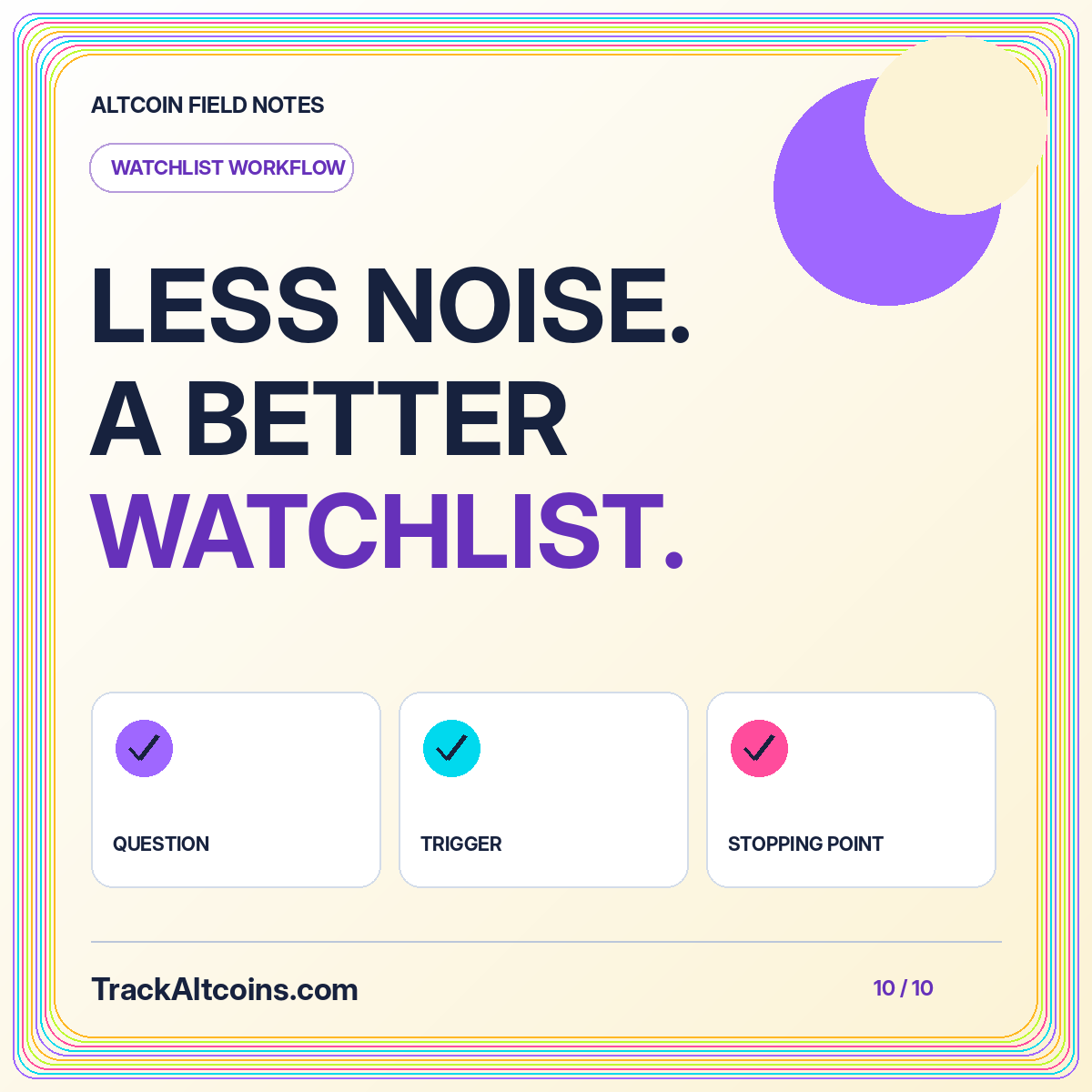
A watchlist should reduce the work of research, not create another stream of urgency. When every interesting token remains on the list forever, the list stops helping you choose what to examine. A better approach gives each entry a purpose, a small set of evidence fields, and a clear condition for review or removal.
This guide describes a research watchlist, not an investment portfolio or a list of recommended purchases. TrackAltcoins.com's altcoin directory lets you save research bookmarks in your own browser. Those bookmarks contain no wallet balances and do not represent holdings. The process below explains how to give a personal research list more structure than a collection of tickers.
Write one sentence explaining why an asset is on the list. Perhaps you want to understand its token model, compare its data coverage, or review a documented upcoming event. “It is trending” can be a prompt for a question, but it is not yet a research objective. Turn the observation into something you can investigate.
A fictional example might read: “I am studying whether this application token has a clearly documented role in governance.” That purpose suggests the evidence to collect and a stopping point. A vague entry such as “possible winner” does neither. The watchlist becomes more useful when its entries describe questions instead of aspirations about future prices.
Record network-aware identity before adding market data. For issued tokens, that generally means the relevant contract or mint identifier; for native assets, state that classification explicitly. Keep the verification source with the record. A symbol is a readable label, but it should not be the only thing preventing one asset from being confused with another.
This step also helps organize related representations. A token on one network, a bridged representation, and a receipt token should not be silently merged because they share a familiar name. The beginner's tracking guide explains how to separate identity from display labels without making a small research list unnecessarily complicated.
A minimal entry can contain identity, research purpose, source, observation date, open questions, and next review condition. Add market information only when it helps answer the stated purpose. If you include price or volume, record the currency and measurement window. A column that nobody can explain is a candidate for removal.
The CoinGecko market-data endpoint reference shows how a provider separates fields such as price, supply, volume, and last-updated time. These are different measurements, not interchangeable indicators of quality. A watchlist should preserve those meanings rather than combine them into a visually impressive but unexplained score.
Use one field for a verified observation and another for your interpretation. “The documentation describes a governance role” is different from “governance will make the token valuable.” The second statement introduces assumptions that need to be examined. Keeping the two separate makes later review easier, particularly when market movement tempts you to rewrite the original reasoning.
Simple stages can describe the work: identity review, documentation review, unresolved questions, monitoring a specific event, or archived. These labels tell you what to do next without implying a recommendation. Avoid status names that quietly turn a research tool into a trading instruction or suggest a level of certainty that has not been established.
Define the conditions for moving between stages. For example, completing identity review might require agreement between two independently reached primary references. Completing a supply review might require a documented denominator and release conditions. The specific process can vary, but the label should correspond to observable work rather than how enthusiastic you feel about the project that day.
A review trigger can be a date or a concrete event relevant to the question. Examples include publication of a technical document, implementation of a governance change, or the arrival of missing data. A vague promise to “keep an eye on it” leaves the list permanently active without explaining what would justify more attention.
A stopping point is equally important. Decide what would answer the question, make it irrelevant, or leave too little evidence to continue. Archiving an entry is not a prediction that the asset will perform poorly. It simply means the research purpose has been completed, changed, or deprioritized. This keeps the list from becoming an obligation to follow every price movement.
Before creating an alert in any external tool, ask what you would do with the information. A price move may not answer your question about governance, token identity, or supply documentation. An alert that produces no defined research action may add interruption without improving understanding. Notification volume is not a measure of diligence.
Use an observation log for meaningful changes. Record the event, the evidence, and the effect on the original question. If the event does not change the research task, say so. This habit helps separate genuine new information from repetition of an existing story. It also gives you a useful summary when you return after a period away.
A research bookmark is not a holding. Keep quantity, custody location, acquisition history, and performance calculations in a separate portfolio record. Mixing them can create accidental assumptions about what you own or why you are watching it. A watchlist may include competing technologies, examples of risks, and assets you have no intention of acquiring.
The portfolio tracker overview explains how to organize actual positions and transfers. Linking a research note to a holdings record can be useful, but the records should remain distinct. That way, removing an asset from your research list does not erase accounting history, and adding an interesting topic does not imply a financial position.
Look at the themes represented in your list. You may discover that many entries depend on the same network or repeat the same product story. This is not an asset-allocation exercise; it is a way to notice whether your research effort is covering distinct questions or repeatedly examining variations of one idea.
Group entries by the question being studied rather than only by token category. A comparison of permission models might span several networks, while a study of supply reporting might include different application types. Such groupings can reduce duplicate work. They also make it easier to identify a missing perspective without turning the list into a ranking of supposedly superior investments.
Store only the information needed for the research task. A public reading list does not need recovery phrases, exchange credentials, or a complete map of your personal finances. If you use browser-local bookmarks, remember that clearing site storage or changing devices can remove them. A convenience feature is not a substitute for a deliberate backup process.
For a portable record, keep plain-text identifiers, source references, dates, and short notes in a format you can inspect. Avoid depending entirely on a provider's proprietary confidence badge. Our wallet safety guide explains why even read-only tools deserve a review of what they collect and how access can be removed.
At a chosen interval, revisit each entry's purpose and unresolved question. Remove duplicates, archive completed work, and correct stale identity or source information. Do not keep an entry solely because you have already spent time on it. The list should represent useful future research, not a record of attention that you feel obliged to justify.
Preserve a brief archive note where it helps: the original question, what you learned, and why the entry was closed. That history can reveal recurring gaps in your process without requiring endless monitoring. A successful watchlist is allowed to become smaller. Its value comes from clarity, not from the number of assets it contains.
A well-designed altcoin watchlist connects verified identity to a specific research purpose. It uses meaningful fields, clear stages, review triggers, and an archive rule. Keep it separate from holdings and protect the information it contains. The result is a manageable research tool that helps you decide what deserves attention and when the work is complete.
Filed under Tracking & Research. Research education, not a recommendation.
Keep exploring
Separate deposits, internal transfers, fees, and investment returns when organizing cryptocurrency portfolio records.
Read the field noteBuild an altcoin research workflow with verified identities, useful measurements, timestamps, and an organized watchlist.
Read the field noteUnderstand market capitalization, circulating supply, and fully diluted valuation with practical examples.
Read the field note