How to Track Altcoins: A Practical Beginner’s Guide
Build an altcoin research workflow with verified identities, useful measurements, timestamps, and an organized watchlist.
Read the field noteTracking & Research
Evaluate purpose, supply, governance, liquidity, and security evidence without confusing a story with a verified fact.
Altcoin research can become a collection of persuasive fragments: a polished website, a rising chart, a technical phrase, and a confident community. None of those fragments is a complete investment case. A useful checklist organizes evidence, separates facts from expectations, and gives you a place to record why a question remains unanswered.
The framework below is educational and does not recommend any token, allocation, or trading action. Crypto assets can involve substantial loss, and research cannot eliminate that possibility. Use the altcoin investing resource page as a companion, and treat “not enough information” as a valid outcome rather than a problem that requires an optimistic guess.
Start with a plain-language description of what the project does and why its token exists. Avoid copying the project's slogan into your notes. Try to explain the relationship between the product, its users, and the asset being researched. If you cannot explain that relationship without a string of promotional terms, identify what you need to learn next.
Separate a product thesis from a token thesis. A useful application does not automatically establish a financial benefit for every associated token holder. Write the mechanism you are trying to verify and the conditions under which it would operate. This approach turns a broad story into specific claims that can be checked or left unresolved.
Record the network, complete asset identifier where applicable, official documentation, and the route used to verify those sources. Keep token identity distinct from the identity of a website or social account. An authentic discussion about a project can still contain an incorrect address, and an attractive search result does not independently establish authenticity.
Check whether important documents agree with each other. If a token description, application interface, and governance discussion appear to describe different arrangements, do not silently combine them. Record the disagreement and the dates involved. A change may have occurred, or one document may be incomplete. The point is to preserve the uncertainty until you can explain it.
Ask who can change the system's important rules. Relevant questions may include contract upgrades, issuance, treasury spending, emergency controls, and access to critical infrastructure. Do not reduce this review to whether the project describes itself as decentralized. Identify actual capabilities and the process through which they can be exercised.
For governance-related claims, distinguish a proposal, a vote, and an implemented change. They are different stages. A forum discussion can explain intent without proving that code or operational controls have changed. Your notes should state which stage the evidence supports. Avoid making assumptions about a participant's motives when the available material only documents an action or capability.
For each major claim, write one observation that would weaken it. For example, a thesis based on a particular token utility should identify what happens if that utility is optional, replaced, or changed. This exercise does not predict an outcome; it makes the reasoning inspectable and reduces the temptation to reinterpret every development as confirmation.
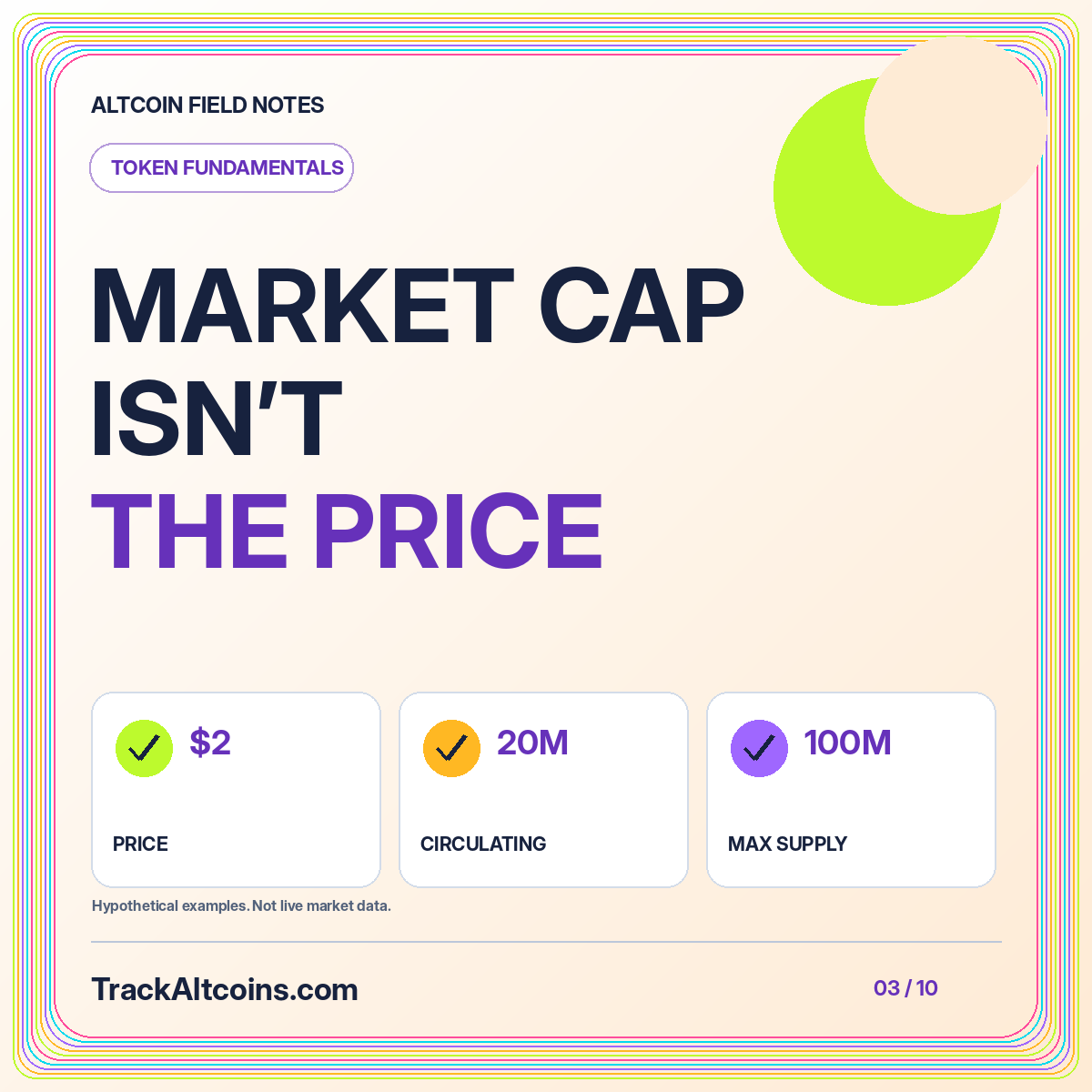
Record circulating supply, the broader supply basis, release conditions, and the observation time. Check which parties control units that may become available. Do not infer a release schedule solely from a market-data ratio. The market-cap and fully diluted valuation guide explains why those figures are useful context but incomplete descriptions of future supply.
Build hypothetical scenarios by stating the assumptions first. A calculation that holds price constant while supply changes answers a different question from one that holds calculated valuation constant. Neither is a forecast. Keep scenario arithmetic separate from claims about future demand, especially when a presentation uses precise numbers to make uncertain expectations appear more established than they are.
Choose a usage measure that corresponds to the project's stated purpose. Then ask what the measure includes, whether the observation window is clear, and how the source defines an active user or transaction. A raw count without methodology can be difficult to interpret. Keep incentive-driven activity and organic demand as questions rather than assuming you can distinguish them from one chart.
Next, ask how usage relates to the token being studied. A network or application can become busier without creating the specific benefit a holder expects. Write down the proposed connection and the evidence for each step. If the connection depends on a future governance decision or an optional feature, make that dependency visible in the research summary.
Find out what evidence exists about trading conditions for the exact asset representation. Keep volume, liquidity, reference price, and venue access separate. Do not assume that a token's displayed value is an amount you could realize for a meaningful position. A research checklist should make room for the possibility that an attractive chart is not a practical exit route.
The liquidity guide develops these distinctions using simple examples. For your notes, record the venue, pair, observation time, and limitations of the available information. You are not required to place a transaction to complete a research exercise, and a request for unnecessary wallet access should not become part of routine fact gathering.
When a project refers to an audit or review, identify the scope, version, date, findings, and follow-up. A review of one component at one time does not automatically cover every current deployment or connected service. Do not treat the existence of a document as a universal safety certificate. Ask what the document actually examined.
Keep operational dependencies in view: interfaces, custody arrangements, bridges, data providers, and administrative controls may sit outside the narrow token contract. A diagram of those dependencies can be more useful than a single risk score. The wallet safety article explains how permission choices add another layer that a project's technical review may not address.
Promises of exceptional returns with little risk deserve skepticism, as do requests to act before you can verify basic information. The Investor.gov crypto-asset investor alert describes volatility, platform risks, and fraud concerns. Its warning is a reason to examine the evidence, not a method for predicting which individual asset will fail.
Keep endorsements separate from supporting documentation. A recognizable person, active chat group, or impressive follower count does not establish the truth of a technical or financial claim. Record sponsorships and conflicts where disclosed. Where they are unknown, say that they are unknown rather than asserting that a promoter is independent or that a relationship definitely exists.
Summarize what is verified, what is inferred, and what remains unknown. State the most important dependencies and the next event that would justify reviewing the record. Avoid compressing every dimension into a number unless the scoring method is transparent and genuinely useful. A written explanation is often easier to challenge and improve.
Keep a dated version of the record even when you decide not to proceed. Rejected ideas can reveal how your process handles uncertainty without requiring financial exposure. Review the quality of the reasoning rather than judging every past decision only by subsequent price movement. A favorable market outcome does not retroactively make weak evidence strong.
A research session can end with a well-defined gap rather than a confident verdict. Suppose a fictional project's token documentation explains governance but leaves your question about supply classification unanswered. Save the specific missing definition and the source you checked. That note is more useful than labeling the project generally confusing or assuming a favorable interpretation. It also limits repeated work: the next review can focus on whether the missing information has become available. Recordkeeping improves when incomplete research has a clear status instead of being silently treated as completed due diligence.
A sound altcoin checklist connects identity, purpose, control, supply, usage, liquidity, and security evidence. It also records where those connections remain unproven. Research is most useful when it can support a clear explanation, including a decision to stop. No checklist removes investment risk, but a disciplined record makes unsupported assumptions harder to overlook.
Filed under Tracking & Research. Research education, not a recommendation.
Keep exploring
Build an altcoin research workflow with verified identities, useful measurements, timestamps, and an organized watchlist.
Read the field noteSeparate deposits, internal transfers, fees, and investment returns when organizing cryptocurrency portfolio records.
Read the field noteUnderstand market capitalization, circulating supply, and fully diluted valuation with practical examples.
Read the field note