How to Track Altcoins: A Practical Beginner’s Guide
Build an altcoin research workflow with verified identities, useful measurements, timestamps, and an organized watchlist.
Read the field noteLINK · Ethereum · Utility token
Investigate LINK with network-specific contract references, rather than relying on a ticker.
Chainlink publishes network-specific LINK token contract references. This profile uses the Ethereum representation as its research scope; it is not a combined balance or valuation of every representation named LINK.
Primary reference: Chainlink’s LINK contract references. Project documentation establishes terminology and described mechanisms; it is not independent proof of safety, liquidity, or future investment returns.
Does my source match the exact network and contract representation I am researching?
A provider’s label can be broader than one onchain representation. Check how its identifier maps to an asset before attaching market data to a wallet record.
Begin with the exact asset representation. Save the network and the complete contract or mint identifier where one applies. For a native asset, label that fact explicitly. This profile is an educational starting point, not a token-address registry; confirm addresses through established primary documentation before any transaction.
Keep reference data separate from interpretation. A source label, token name, or logo is not a substitute for a verified identifier. If your source combines multiple networks, record that scope rather than assuming it matches the representation in your wallet.
This page intentionally contains no price, percentage change, volume, or supply snapshot. Those observations require a source, currency, timestamp, and methodology. When you collect them elsewhere, preserve those fields and distinguish an unavailable value from zero.
Our market-cap guide explains supply assumptions. The liquidity guide explains why a reference price does not establish an executable outcome.
Write down the permissions, operational dependencies, and data gaps relevant to your question. Identify which claims are documented, which depend on a current observation, and which remain interpretations. A short list of unresolved questions is more useful than an unexplained confidence score.
Save this profile as a research bookmark, then use the research framework to build your own evidence record. Saving a profile is not an investment action or endorsement.
Altcoin Field Notes
Build an altcoin research workflow with verified identities, useful measurements, timestamps, and an organized watchlist.
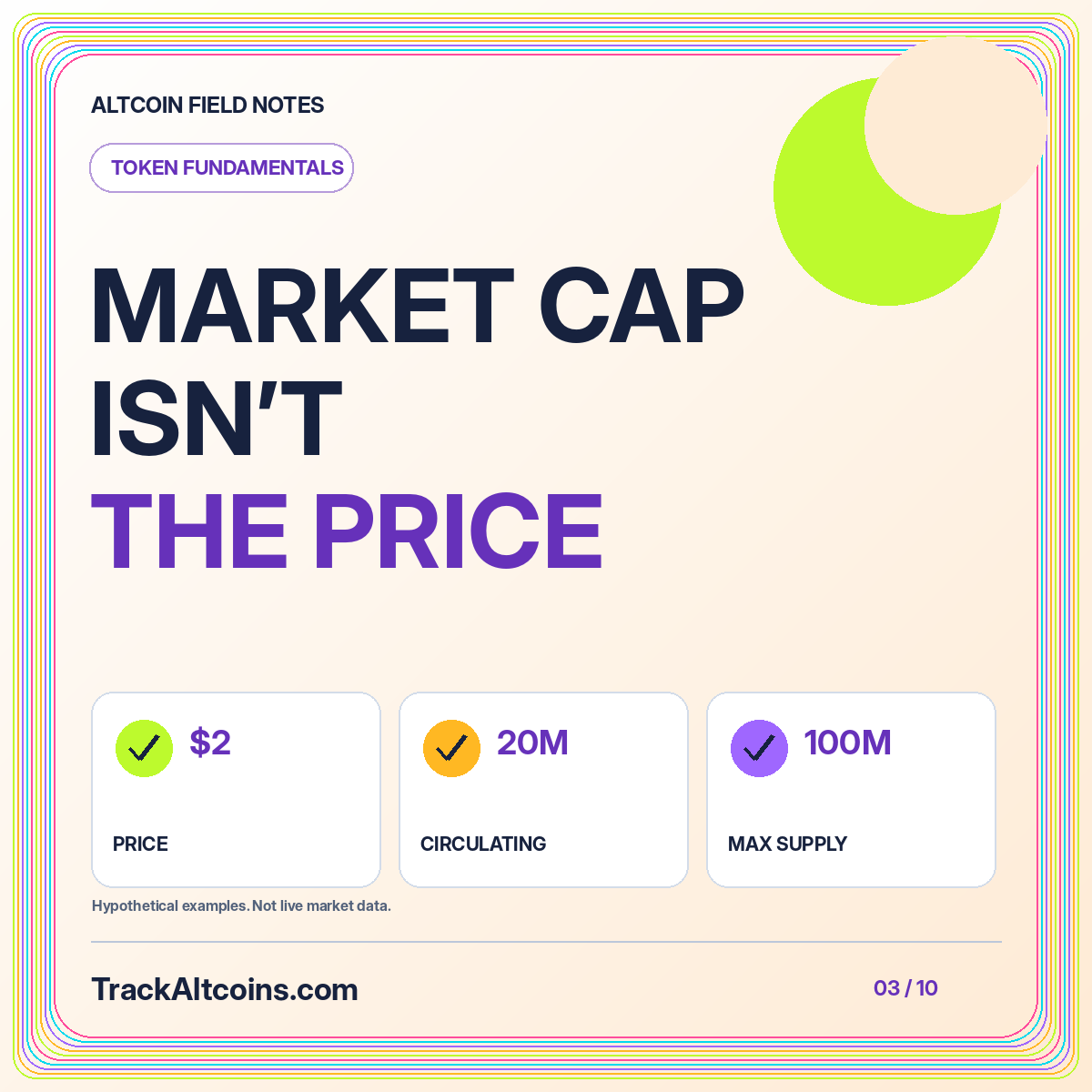
Read the field noteUnderstand market capitalization, circulating supply, and fully diluted valuation with practical examples.
Read the field noteEvaluate purpose, supply, governance, liquidity, and security evidence without confusing a story with a verified fact.
Read the field note